
Hello, me again. Thanks Rich for an excellent Update last week. I must say I’m not a fan of 2026 so far. It has had a couple of good bits, but far more demerits and should now be considering its position before getting placed on a Performance Improvement Plan.
I’m #delighted this is the last Update of January, and even more #delighted that I’ve got some Actual News to write about which isn’t to do with the imminent destruction of civilisation as we know it.
And so our eyes turn West to the Beast from Bristol, who has announced a 0.1% cut in its main custody fees, balanced with a bunch of other changes including introducing fund trading fees. This is quite bold, and we should pay attention.
The reason we should pay attention is that HL is of course a behemoth and a bellwether for the sector. That isn’t to say it’s a pricing anchor for others; most everyone has been way cheaper for ages, but in the main they don’t have two million clients and the thick end of £200bn and HL does.
I remember doing investor presentations a decade or so ago, and being asked by various Kenneths and Henrys how long it was reasonable to assume HL would defend its famously toppy 0.45% charge for. Not being Punxsutawney Phil (who by the way will be doing his schtick this weekend) I would generally say I didn’t know the answer, but as long as they were growing and continuing to punch their considerable weight, they wouldn’t be rushing to change for the sake of it.
Anyway, here’s a thing: HL is still growing handily. It’s still punching its weight in all kinds of areas and is still the one everyone wants to beat. It’s also now a private company after delisting in March last year, so the nip-nip-nip scrutiny of being a listed business is reduced, and that will be a relief. So why has it cut its own throat now? Especially when it has some big tech spend coming up, and when it’s clear there’s lots of other strategic change to deal with?
Most folk will say it’s because of competitive pressures; neo-platforms coming on at low low low prices and the other big shops like ii and AJ Bell YouInvest eating its lunch. I’m sure that contributes, but I’m not sure it’s what it first appears. I don’t think it’s cut its own throat at all.
Let’s do some arithmetic. The average holding on HL per client is around £90,000 (not that averages are much help, but hear me out). We’ll bump that up to £100k for fun. So let’s take a £100k ISA portfolio, which trades in funds 10 times a year. Here are a few key runners and riders:
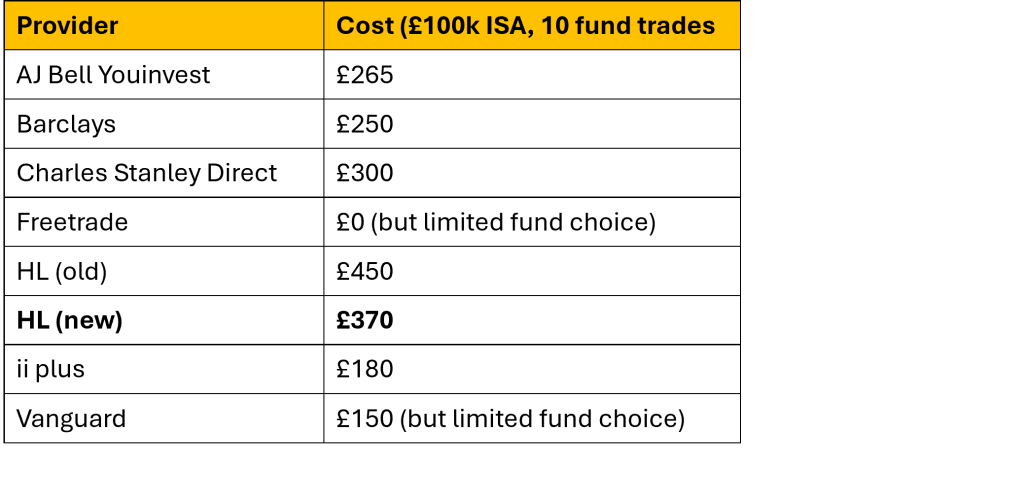
Let’s not get too excited – that new trading charge really does pull back the discount a bit. So a question: if you were on a defensive price play strategy to stem outflows, would you choose to be £190 a year more than a key competitor like ii for this fictional client? I’m not sure I would.
HL has a very broad proposition now, and I think that might be the key to some of what’s going on here. Yes, they’ve closed the loophole for some of the ETF freeriders by introducing custody charges to the GIA, and that’s fine. Yes, if you only trade once a year on your £250k SIPP into a multi-asset fund you’ll save £247 a year and that’s good. And if you’re a price-hound with straightforward investment needs you can get the in-house multi-asset thing plus your product charge for 0.45% all in, and that’s not terrible. If you’re a cash-hound you have the active cash savings thingy, and if you’re a workplace client with regulars going in you won’t pay fund trading charges anyway.
So what gives in that core segment? I wonder if HL isn’t spotting investor behaviour patterns change. Maybe there’s more trading on ETFs and investment trusts. Maybe trading volumes overall are rising; maybe HL sees outflows to competitors who don’t charge a ruinous £11.95 a pop. Maybe dropping those trading charges for ETIs and introducing them for funds is the real story, and the 10bps cut isn’t as big a deal. It’s many things, is HL, but none of them are stupid, and I’ve got a feeling this isn’t just a straight-up act of bottom-line self-harm.
The UK D2C market is a funny old place. Sticker price is a poor determinant of flow. There is a price-seeking segment of the market, and that segment is often rooted in active trading behaviour, which is where guys like ii and Freetrade go to work. There is another segment, at least as large, which is much less bothered, and just wants a name they know and to be confident their money will be there tomorrow. If HL has spotted that that segment is changing its behaviour, then we might be able to make a bit more sense – in the round, allowing for cash margins and all the rest of it – of what’s happening here.
One further thing – there seems to be a belief that HL doing this will get others reviewing their pricing structures with a view to sharpening them. I think they will do that review and will make a change – upward. Someone had to go first with removing free fund trading. Watch for others breathing a sigh of relief and following suit. And if you’re an adviser reading this – watch very carefully for contagion of fund trade charging crossing the floor into the advised platform market.
Fun times…
Your music choice this week is for a real life rain dog: my friend Steve, who got lost and couldn’t find his way home. I’ll miss you, man. Thanks for introducing me to Tom Waits, and for many other things. Here’s Singapore.