What up TCWU fam. It’s Rich Mayor in the driving seat this week. I trust you’re all keeping well. You must have been wondering what I’ve been up to. Well, since the last Update I ran the Great South Run in Portsmouth. Before I started running – for fun – a couple of years ago, I reserved placing one leg in front of the other in a repetitive fashion for two things: playing football or being chased.
But now I’ve done it a bit I can confirm it’s quite good for the old noggin generally and does, from time to time, dump a dose of endorphins into the brain. It is also the absolute pits if you get tendonitis or shin splints. The Great South is the only one I’ve done for two big reasons: I can get home easily and it is very flat.
But this time was also a timely reminder of all the good parts of the city. From the start to the finish the locals lined the streets, cheering you on the whole way round, handing out water and blasting out the filthiest drum and bass you could reasonably hope for on a Sunday morning.
You see, my home town has been in the news for some wrong, balaclava-cladded reasons in recent times, and I’m not going to say that hasn’t irked me a bit. But this was super wholesome, supportive and all the best things about the city.
Uvverwise I’ve been looking at platforms and crunching their respective numbers into a paste of analysis to spread on your brunch. First up, advised AUM is up a smidge to a cool £819bn and the split of growth from markets and from net sales are pretty evenly split. In recent times, growth from markets has been the main contributor to asset growth, and over the past ten years or so, cumulatively market growth has outstripped the cumulative net sales.
What that really means now is a few things. First that because the market is absolutely enormous, positive markets (like we saw last quarter) can mean many billions of pounds of growth and some sweet, sweet revenues for platforms and advice firms on ad valorem charges (most). It also goes some way to highlighting that as well as being massive, the platform market is also a maturing market. Net sales at an aggregate level nowadays are a far cry from what they were even a few years ago as people quite rightly want access to their money to realise the future they’d planned for, or to stack the bunker in the garden with 14 years’ worth of tinned mulligatawny.
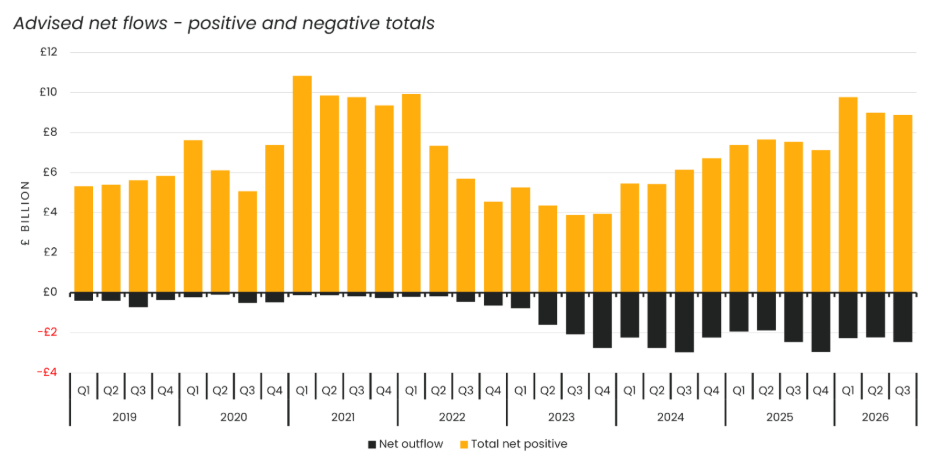
Of course, not every platform shares the aggregate view equally. Quilter’s numbers this quarter hit familiar, with about £5bn of gross sales and about half that as net, but these are not normal numbers so far as history goes. Aviva and Transact make the other two podium spots as usual, with total podium spots making £10bn+ of £26bn total gross sales, and £4.7bn of a total £6.4bn net sales across the advised platform channel aggregated numbers.
You might be wondering how the net figure is even really possible considering there are some 20 odd platforms in the market, and that’s because some are in net outflow. That makes market share for net all a bit weird, and it has done for some time.
Which leads us seamlessly to Robert Pattinson, the new Bond. I’ve just finished a piece of research which shares the views and opinions of advice professionals on their use of onshore and offshore bonds. It’s called The Great Bond-anza, and is already collecting accolades for being the worst ever name for a report. Not even just the worst named lang cat report. I am not on the committee to decide the name of the film for Mr Pattinson’s debut.
I and many other cats have banged on about bonds for some while now. That’s because it’s come up in most conversations with providers and a fair number of chats with advisers. We saw the trends coming in the platform numbers but wanted to get into what the experience was like nowadays, where the pain points are and what the future might hold.
First up, no respondent said they were using bonds less. Two-thirds are using more since the Pensions IHT change announcement. Over half of respondents are using more trusts with bonds than in the past. But for some, the resurgence has surfaced some gremlins in the process. The biggest barrier to writing more bond business was around administration, in that it should be faster and simpler and much more like the experience placing just about any other platform business.
The upshot for the platforms is that this provides a route to some stickier flows. It means more net sales in an environment where they have been difficult to come by, while also serving adviser and client needs. Great!
Anyway, best not write the whole report here. Give us a nudge if you’d like to get your hands on it.
Music choice this week is from a band I really like called Reuben. A UK three piece that made a heck of a lot of noise back in the day and that have now reformed to play at least one show next year. Here’s Stuck in my Throat, by Reuben from one of my all-time favourite records, Racecar is Racecar Backwards.
All the best, and none of the worst
Rich